case study 02 · robots in public spaces
TrailMate Station
A solar kiosk at the trailhead that quietly pairs hikers who'd get along, using a wristband that glows and pulls when a match is near. No names, no profiles.
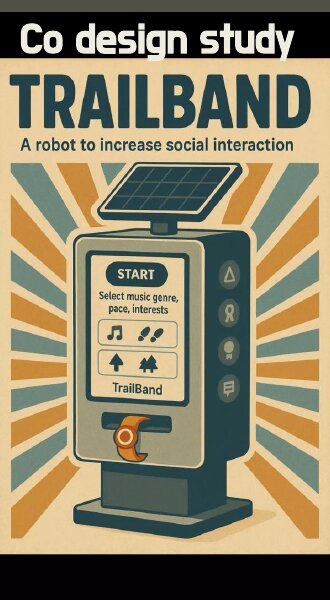
How a match happens
step through it
When another hiker with a matching profile is close, both bands light up, vibrate and give a gentle push-pull.
Why TrailMate, not Poemi
We started with two concepts. Poemi was a mood-lifting robot that prints AI poems on eco cards. We compared them on what matters in a public space.
| Poemi | TrailMate | |
|---|---|---|
| interaction | Individual, isolated | Shared, in the real world |
| social connection | No human-to-human bonding | Mediates bonding between hikers |
| content value | Easy to replicate with any AI tool | Tied to a place and a shared moment |
| depth | Read or print a poem | Sparks conversations |
The co-design study
before
Set objectives and the onboarding flow, recruited hikers, and built an iPad kiosk mock-up and TrailBand mock-ups.
at the trailhead
Consent and warm-up, a scenario walkthrough, then an anonymous pre-hike survey on the kiosk: pace, mood, companion type.
on and after the hike
Logged tap confirmations, noted reactions and body language, then ran a post-hike interview with deliberately playful prompts.
“What if the band activated and it turned out to be your thesis supervisor?”
What hikers told us
Barriers broke
Strangers became friends; solo hikers and introverts joined in.
“I came alone but left with friends.”
Nature felt richer
Pairs found hidden trails, and shared wonder lifted the walk.
“The trail felt different when we explored it together.”
Confidence grew
People stepped out of their comfort zone and planned future meet-ups.
“I never thought a robot would help me talk to people!”
What we'd change
- Context awareness
- “It shouldn't buzz when I'm crossing the road — that felt dangerous.”
- Anonymity and safety
- “It's risky when I don't know who I'm going to meet.”
- Quieter in nature
- “It felt like tech was pulling me out of the moment.”
The bigger lesson from the seminar: public robots work best as facilitators, not replacements for human connection, and trust has to be designed in from the start.